
Construction Products Regulation (CPR) and ESPR. EPDs and declarations of performance must be connected to product records as requirements come into force.
All industries
Digital Product Passports for Construction and built assets.
Construction products and materials such as cement, steel, aluminium, facade systems and fixings.
Book a demo
What changes for you.
Scope and timing depend on the product and applicable rules. This is not legal advice.
Materials are tested once and produced for years. The data exists across test certificates, EPDs, technical datasheets and production logs. A passport structures these once so they do not have to be assembled per project.
What matters for construction and built assets.
Materials are tested once and produced for years. The data exists across test certificates, EPDs, technical datasheets and production logs. A passport structures these once so they do not have to be assembled per project.
Data that matters.
Start with what you have. Gaps stay visible and can be filled as supplier data arrives.
| Data | Where it comes from | How Arkive uses it |
|---|---|---|
| Declaration of performance (DoP) | CPR technical documentation | Brings declaration data into the record |
| EPD and LCA data | Environmental product declarations | Connects existing EPDs without re-entering |
| Material composition | Bill of materials, supplier declarations | Maps substances and recycled content |
| Installation, maintenance, disposal | Technical documentation | Tracks replacement parameters over the asset's life |
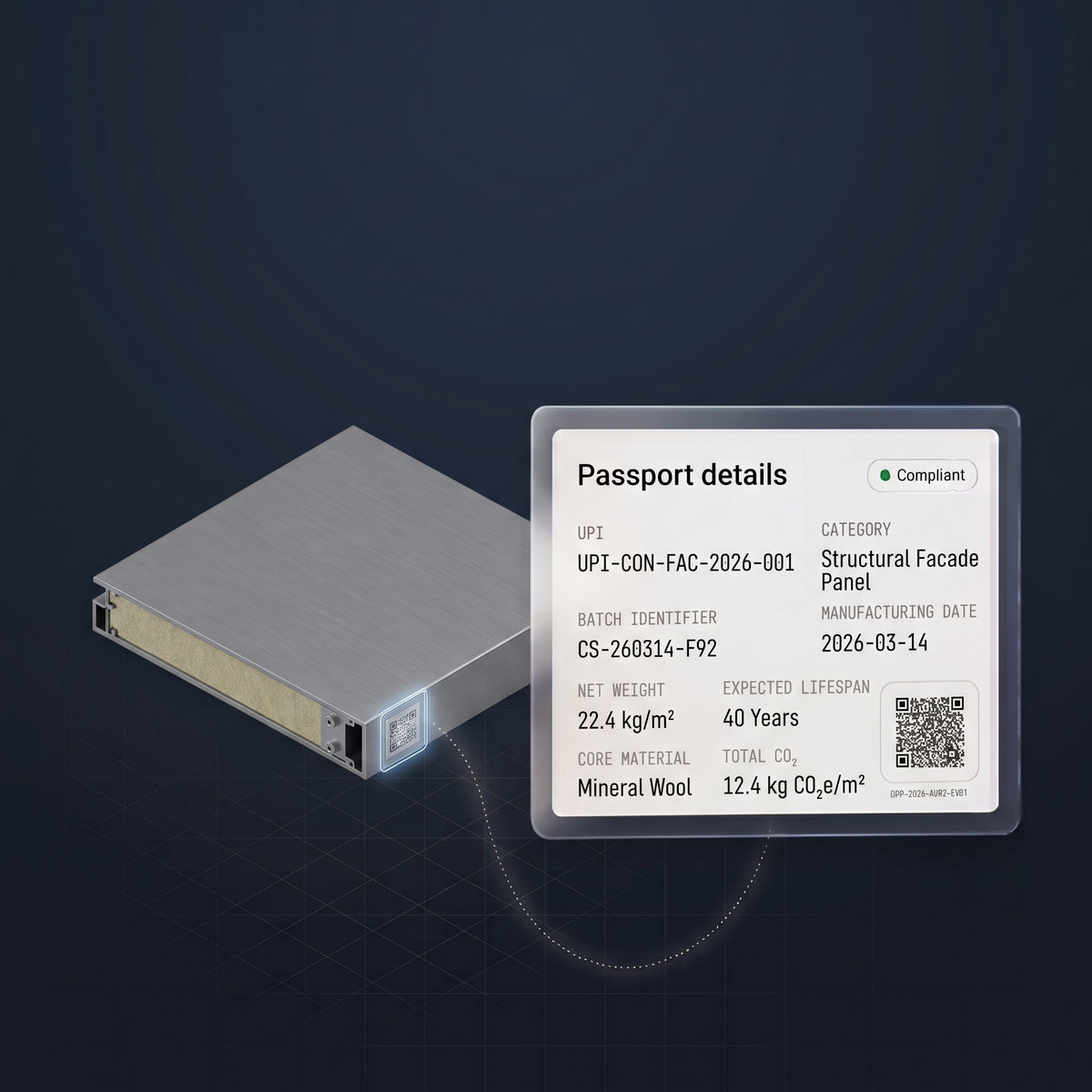
A facade panel passport, in practice.
ILLUSTRATIVE EXAMPLE
A facade panel passport can hold its declaration, EPD, origin, emissions, composition and replacement information.
Illustrative product example, not customer data.
Start with one product.
01 · Send
Upload a spreadsheet or connect your API.
02 · Check
Review the passport, footprint and gaps on real product data.
03 · Scale
Use the same mapping for more products as supplier data arrives.
Questions, answered.
Can we use the EPDs we already have?
Yes, and you should. Arkive brings your existing EPDs into the product record instead of starting again. For each EPD it keeps the declared unit, the modules covered (for example A1 to A3, or A1 to D), the PCR, the programme operator, the verifier and the expiry date. An EPD that has expired, or that covers a different product variant, is flagged before it reaches a passport.
Our supplier sent one CO2 number. Is that enough?
Not on its own. A figure like 1.8 only means something with its unit (per tonne, per m² or per piece), its scope (direct emissions only, or including electricity and other indirect emissions), the reporting period, the installation it comes from and the method used to calculate it. Arkive asks for these fields with every emission value and keeps the value marked as incomplete until they are there.
A supplier says their steel or cement is green. Can we use that?
Only with evidence behind it. Arkive asks which production route was used, at which installation, over which period, and which document backs it up. A claim without that stays visible as a claim, not as data, so it never ends up in your passport or your tender as a fact.
Who verified the data, and can our customers see that?
Every value in Arkive carries its source and status: verified by a third party, declared by the supplier, or estimated. The verifier and the document are stored with the value. Customers, auditors and tender teams see the same picture, and you know which data is strong and which still needs work.
What should we ask our suppliers for?
One structured request instead of a long email thread: the installation, the reporting period, the emission value with its unit and scope, the calculation or monitoring method, the verifier, and the CN code of the product written in the standard way, for example 7208 39 00. Arkive turns this into a supplier request and checks what comes back, so you don't have to chase missing details per project.
We also report under CBAM. Do we collect this data twice?
No. For steel, aluminium and cement, the supplier data you need for CBAM (installation, period, embedded emissions, method, verifier, CN code) is the same data a construction product passport and an LCA rely on. Arkive stores it once per supplier and product, so the same verified record can support both.
Do all construction products follow one deadline?
No. Under the revised Construction Products Regulation, digital passport requirements arrive per product family, through technical specifications that are published step by step. EPD requirements from customers and tenders often come earlier. We help you check what applies to your products, but this is not legal advice.
Can we start before all supplier data is in?
Yes. Start with one product and the data you have today. Gaps stay visible in the passport and in your dashboard, and they fill in as suppliers respond. Your first 5 passports are free.
Start with the product data you have.
Try Arkive with 5 passports or talk to us about your category.
Start with one panel passport.
Use the data you have today. Try Arkive with 5 free passports, or talk to us about your category.